A friend of mine conducted a gardening experiment. Instead of planting any seeds into his balcony containers, he decided only to improve the quality of their soil, leaving the rest of the gardening tasks to wind and rain. Living next to the Père Lachaise cemetery in Paris, a diverse urban ecosystem, he was curious to see which seeds the wind would carry into his small urban garden.
Another friend, living in the suburbs of Paris, told me about his efforts to befriend the crows and ravens of the neighbourhood. I learnt that crows are smart creatures and enjoy challenges, such as breaking the shell of a walnut. Every morning, my friend leaves walnuts for the crows, waiting to see if they disappear during the day. The habit started while he was carrying out his military service in Tehran, Iran, during which he spent 17 months approaching birds by gifting them little edible offerings. Instead of seeing the birds as a nuisance, the acts express curiosity and a caring attitude towards the crows, as he spends time learning about their habits.
Clouds, as Clément writes, indeed contain unexpected landscapes.
These experiments and gestures reveal an attentiveness towards other, non-human ways of inhabiting and making the city. In the past years, multiple voices have emerged in the Francophone world that are advancing a language for more sensitive, polyphonic ways of living together with other species on our damaged planet.1 Their work is developing a new vocabulary for moving past the nature–culture binary.
One of these writers, landscape architect and gardener Gilles Clément examines the ways in which air serves as a medium for the migration of plants, as planetary forces circulate seeds and pollen to new territories: ‘Plants travel. Grasses above all. They move in silence like the wind. One cannot do anything against the wind. By harvesting the clouds, one would be surprised to gather weightless seeds mixed with loess, fertile dust. In the sky, unpredictable landscapes are already taking shape’.2 Nurturing and nourishing the soil brought grasses and ivy to the miniature wild garden of my Parisian friend. Clouds, as Clément writes, indeed contain unexpected landscapes.
Living compositions
Making a garden is a strange act, as it means making worlds with other forms of life. Designing landscapes and composing gardens means working with plants—bodies of other living beings radically different from ours. These bodies are capable of transforming rock and light into air, as Italian philosopher Emanuele Coccia writes with regard to photosynthesis in his seminal book The Life of Plants: A Metaphysics of Mixture.3
Working as a landscape architect reveals the many ways our culture still considers plants merely as props. In architectural projects, plants are often treated as decoration, not as vital parts or important actors in creating liveable space. Many of us find it difficult to notice and understand the ecological functions of plants and biomes, to see them as forms of life that make the world liveable.
As Coccia writes, being a lifeform equipped with a pair of lungs means being submerged in the byproduct of plant life—the atmosphere. The philosopher reminds us that air and atmosphere are artifacts, products of the life processes of living beings. By producing air, plants, microbes and other photosynthesising organisms make the world a habitable place.
Air is also a habitat and a container for all kinds of living beings—birds and insects, but also imperceptible particles and organisms: pollen, seeds, fungi spores, viruses, and microbes. Intimate corporeal encounters with microbes, viruses, and synthetic particles take place in our every breath. As we cannot stop breathing, we have no choice but to stay in this immensely intimate relationship with the creatures and particles inhabiting the air.
Citizens of the sky
Urban skies are full of life. Cities are, despite their obstacles and challenges, habitats for winged creatures—birds, dragonflies, butterflies, beetles, bees, wasps, ants, flies, moths. Aware of my own lack of sensibility regarding the life around me, I find myself tracking it in the air, following the non-human winged citizens of Paris.
I do not have to explore the city completely without guidance. Signs pointing at the biodiversity of the city put up in the parks remind me how Paris is home to crows, green woodpeckers, common blackbirds, Eurasian jays, goldfinches, ailanthus silkmoths, and pale tussocks. An essay by Frédéric Jiguet, an ornithologist and professor at the Museum of Natural History tells that Paris is also inhabited by black crows, European hawks, common sandpipers, jackdaws, common kestrels, and grey herons.4 Having this knowledge increases my chances of noticing them. I encounter great cormorants on the banks of the Seine, finding refuge in the long rows of plane trees to dry their wings. Instead of forming large colonies that destroy ecosystems like in the archipelago of Helsinki, here they seem like harmless visitors.
If it were still summer, the sky would be filled with common swifts—birds that spend most of their life in air, as their physiology prevents them from landing on the ground. In many European cities and towns, the common swifts are frequent neighbours, as they nest in the nooks and cavities of buildings. In November, the flocks have already started their migratory path towards Africa.
It is not only the plants who travel – aesthetic preference and plant trade make insects gain new territories too.
Coming from Helsinki, a capital with an urban history radically different from Paris, I notice that what is considered biodiversity here is something other than what is considered biodiversity in my hometown. As a result of late urbanisation, Helsinki still has several areas of old-growth forest, many of which are in better ecological condition than the pine plantations covering the rest of the country. The city—where the central park is rather a central forest—is a shared living space with species such as white-tailed eagles, otters, badgers, flying squirrels, and deer. Wolves and lynx sometimes visit Helsinki, while moose and deer can be seen swimming from island to island in the archipelago. Paris, on the other hand, is a city with each square millimetre transformed since its founding as the Roman town Lutetia in 52 BCE. Alongside many other European cities, Paris desperately struggles to find space for reintroducing urban greenery and non-human living beings into the city after centuries of exclusion and separation. Despite its current state as a dense European metropolis, Paris is a city with a myriad of bizarre cross-species stories waiting to be told. The existing urban ecology offers unexpected encounters due to colonial plant trade, urban botany, and escaped domestic animals gaining territory in the urban landscape.
One of these urban curiosities is the rose-ringed parakeet, a lime-green feral parrot. The first time I witnessed the animal, I thought it was a lost pet. Only after a flock of fifty birds emerged, I understood that the bird was not just a lost individual, but a new, commonplace resident of the French capital. The parakeet, however, has a controversial status, as it is considered a threat to the local bird species.
Another curiosity is the ailanthus silkmoth, whose host tree is Ailanthus altissima, commonly known as the tree of heaven—a fast-growing deciduous tree native to China and Taiwan. Ailanthus has likewise a controversial reputation—aesthetically pleasing, it has become widespread in many other parts of the world, particularly in urban areas, and is often regarded as an invasive species outside its native range. The lives of the moth and the tree are entangled, as the ailanthus silkmoth lays its eggs on the leaves of the tree. It is not only the plants who travel—aesthetic preference and plant trade make insects gain new territories too.
Traces of care
In Metamorphoses5, Emanuele Coccia writes that future cities are to become museums for contemporary nature—places where living species from all over the planet can meet and live together. To an extent, this reality is already taking shape in Paris, not only as the gathering of strange creatures from all around the world but also as a slowly emerging gallery of artworks and architectural interventions that re-imagine this cohabitation.
Care for small winged creatures is central in the work of the French artist Raphael Emine, who imagines sculpture-nests, cocoons and refuges for small living beings such as insects and micro-organisms. The ceramic works are entomological utopias, palaces of multispecies dreams, envisioning a shape for urban cohabitation. The works, placed in gardens, courtyards, and other outdoor pockets of the city, imagine a new aesthetic dimension for sharing urban space with insects. They stand in stark contrast with the usual hostile attitudes towards small but important living creatures.
In 2023, in the context of a lecture Emmanuelle Coccia gave in Helsinki, I had a chance to ask him how the new ecological paradigm translated to landscape architecture. In response, I received some challenging homework: ‘Landscape architecture is one of the most important art forms of the future. I don’t understand why no one is saying it. But your generation should be more violent. You should be writing manifestos’. Luckily this homework does not have to be solved in isolation. I attend a Biodiversity Forum in Centre Pompidou, bringing together scientists, researchers, artists, and designers to imagine a culture of the living. The sound installation Nature Manifesto, composed for the Forum by Björk and Aleph, echoes on the ‘caterpillars’—the iconic escalators of the building—evoking a call to reimagine biological assemblages and rhizomatic entanglements. Listening to the manifesto, I feel assured that a multispecies city is not a distant ideal but an already present reality. It is present in the everyday gestures of reaching towards otherness—whether this otherness comes in the form of swallows, silkmoths, ravens, beetles or the invisible planetary forces of wind and travelling seeds.
ELLA PROKKOLA is a Finnish landscape architect. She studies how multispecies thinking impacts the construction culture. She is currently a resident at Cité Internationale des Arts in Paris.
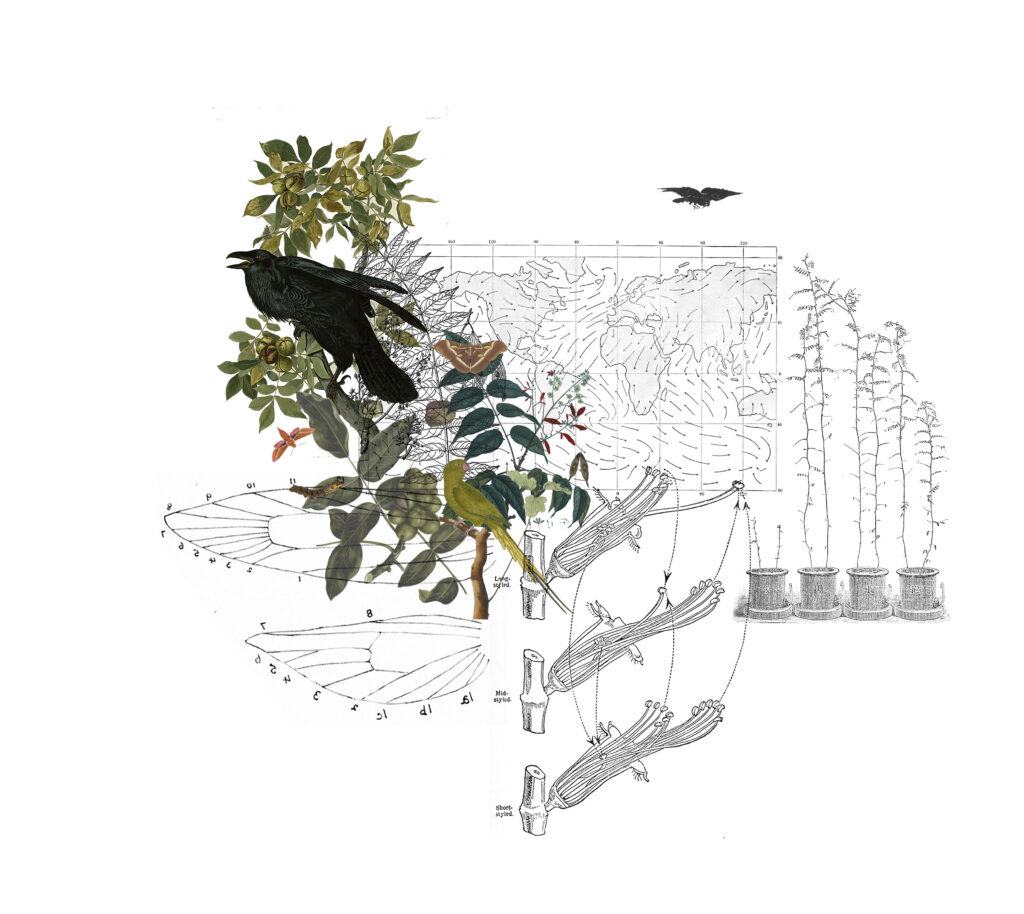
HEADER illustration by Ella Prokkola
PUBLISHED: MAJA 4-2024 (118) with main topic AIR
1 See the work of authors such as Gilles Clément, Bruno Latour, Philippe Descola, Vinciane Despret, Baptiste Morizot, Frédérique Aït-Touati, Emanuele Coccia, and Estelle Zhong Mengual.
2 Gilles Clément, Éloge des Vagabondes (Nil Editions, 2002). Author’s translation.
3 Emanuele Coccia, The Life of Plants: A Metaphysics of Mixture (Polity, 2018).
4 The essay can be found in the catalogue of Paris Animal, a recent exhibition in Pavillon de l’Arsenal focused on the animal history of Paris.
5 Emanuele Coccia, Metamorphoses (Polity, 2021).