TITLED
Type: Installation art on traffic islands in Tallinn
Location: Tallinn, Estonia
Author: Madli Kaljuste
Year: 2021
Botanical consultant: Iti Jürjendal
Technical support: Mihkel Säre
Event: International Urban Triennial CITYA in Tallinn
Curators: Madis Luik, Kati Ots, Liina Siib
Funding: Kultuurkapital
It happens to me quite often at exhibitions that before looking at the artwork, I conscientiously read the accompanying label or title. Sometimes I might even forget to look at or listen to the work itself.
Embarrassing as it is, this seems to be common practice. There is this strange faith in the written word according to which anything that comes with a comment or has been assigned to a category seems to have a bit more existence than everything else. And things labelled with an iridescent golden engraving are particularly existent and important (right?).
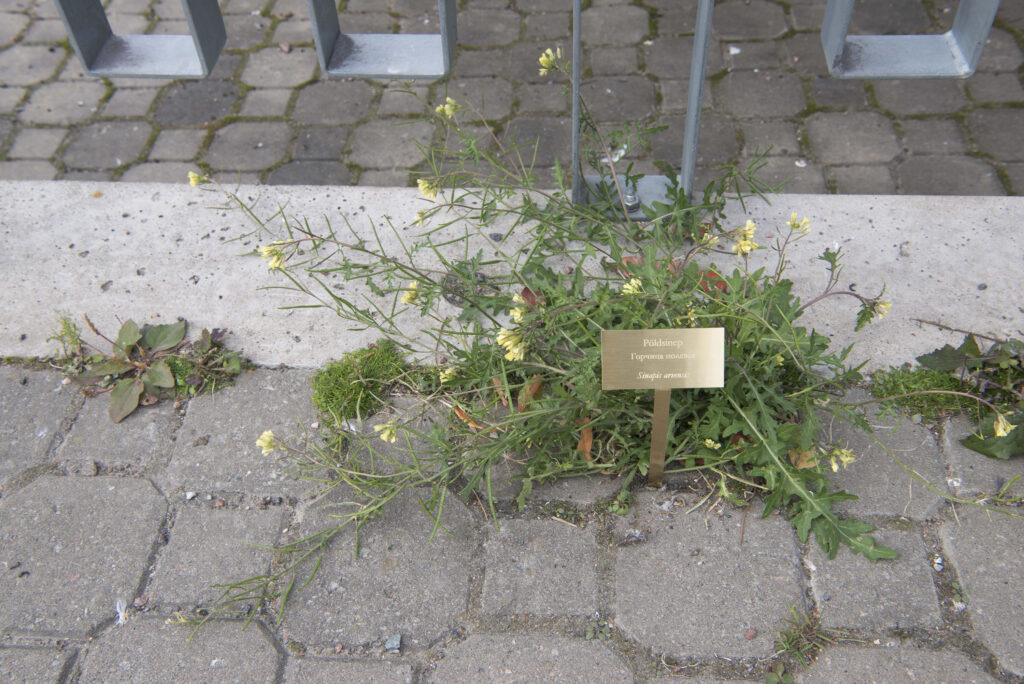
Marking down the scientific names of plants invites one to notice the living beings around us whose vital functions are a necessary condition for all other life on this planet. But it also draws attention to the regulative nature of language and naming. Does reading the explanation and trusting the name somehow diminish the sensitivity of perception? Installations Titled and Titled II follow the trail of ruderal plants and other botanical creatures—the brass labels placed at the traffic islands on Mere Ave. (2021) and at Linnahall (2024) in Tallinn mark the names of these most ordinary plants.
The most typical islands in Tallinn are traffic islands. Their geometry and shape are determined by turning radiuses, all sorts of norms, and innumerable standards, and yet, they seem to be almost spontaneous. Importance is attributed to the adjacent road and the cars speeding by. However, over time, these islands come to host a variety of interesting, or, well, actually rather common and ordinary life forms. A bit of grass, a dandelion blossom here and there. Plants quietly prevail even amidst fields of asphalt.
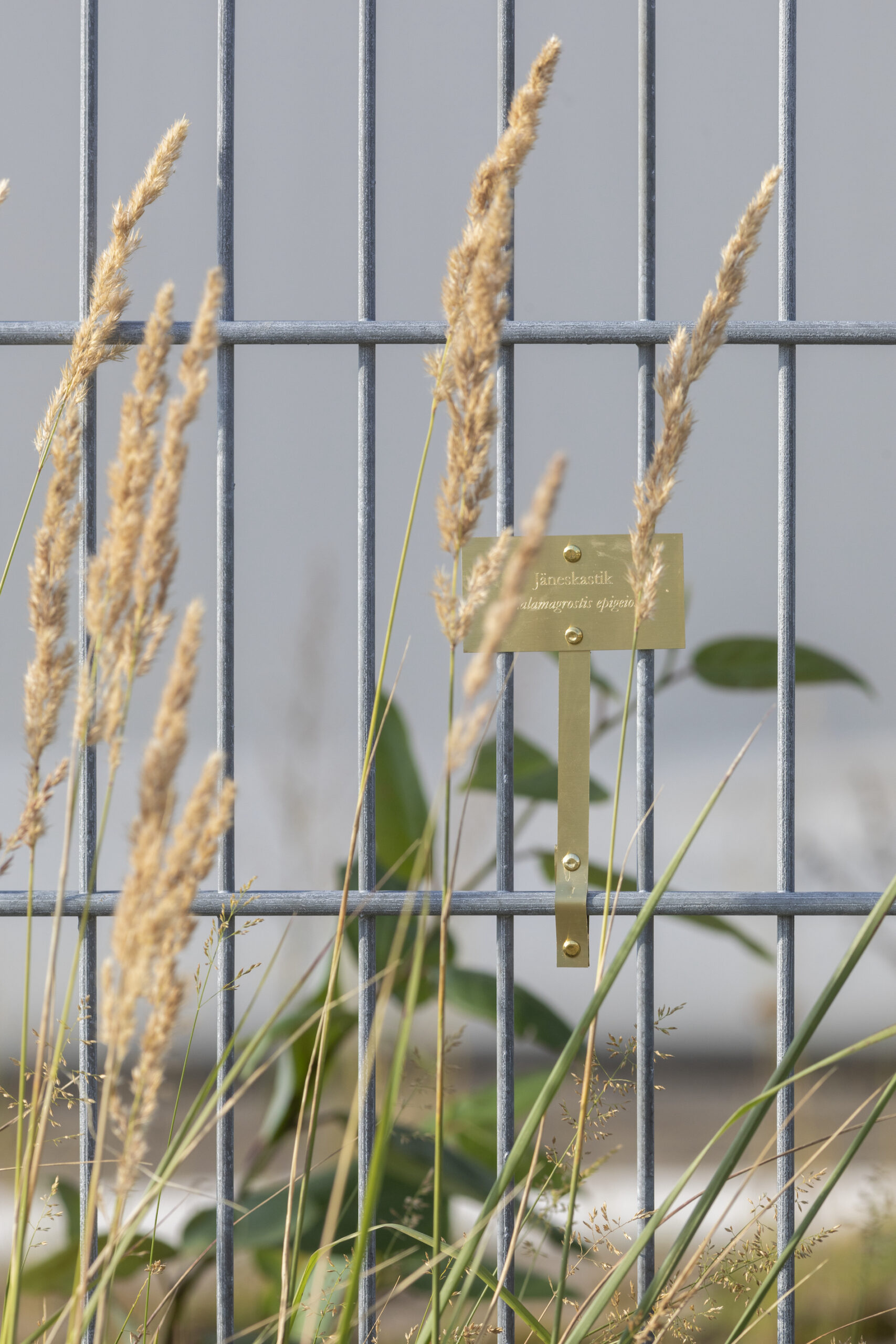
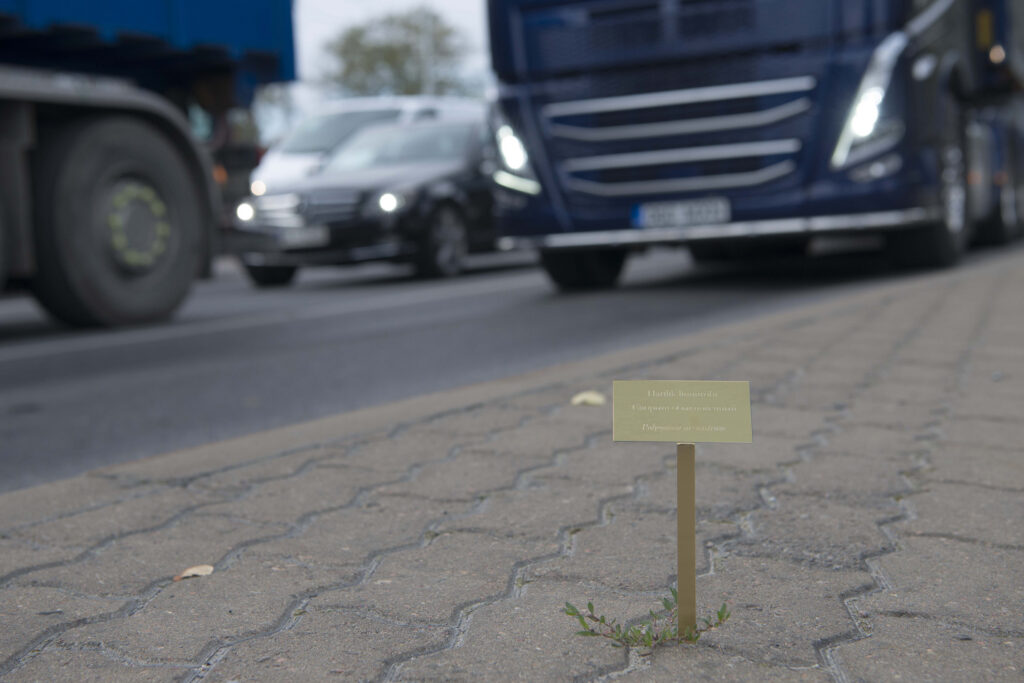
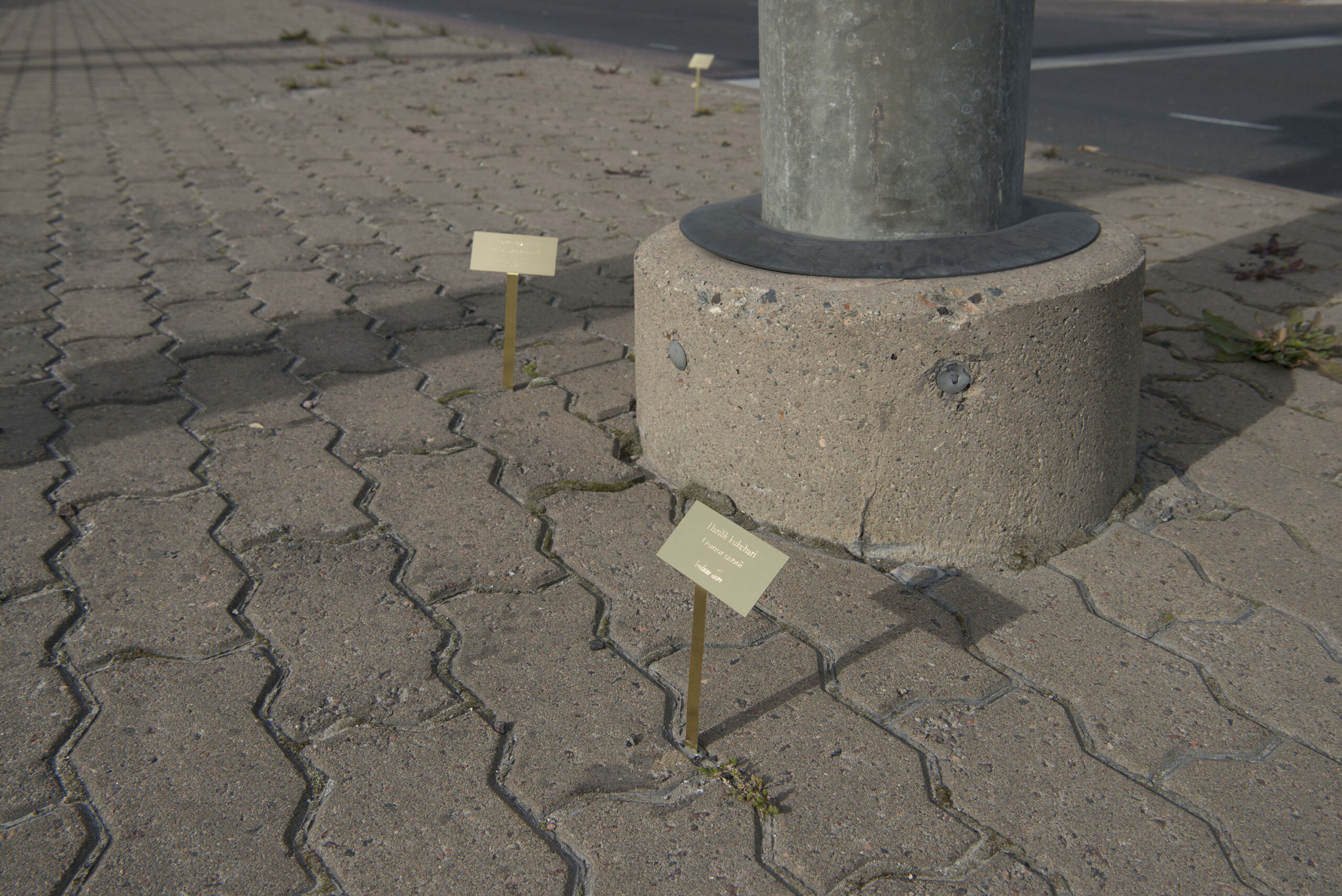
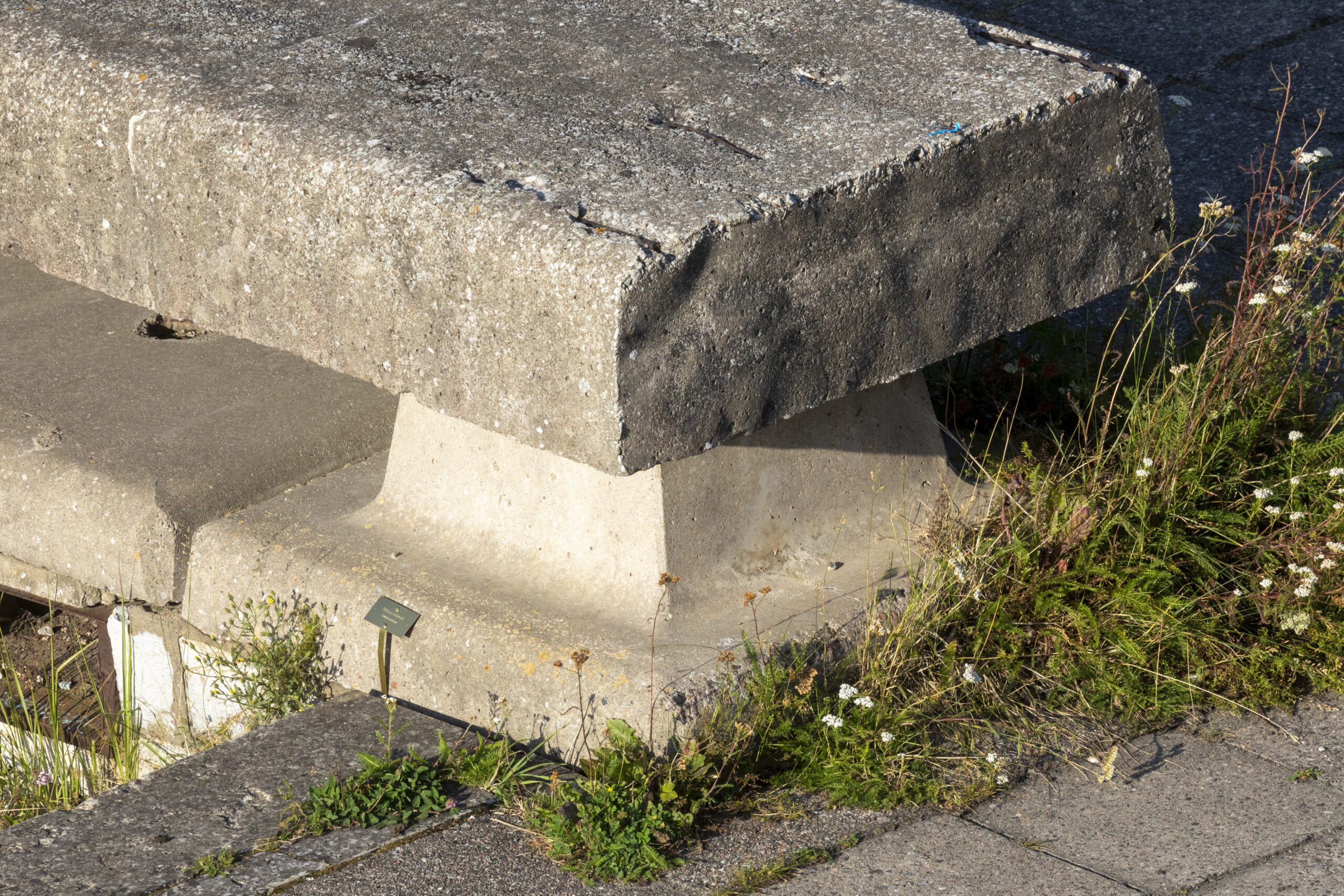
The installation was in place for about two weeks. In my most pessimistic estimations, I predicted that all of the forty brass labels will disappear without a trace in a couple of days. They did not. Instead, there were more curious developments. Although some of the iridescent labels did disappear in a couple of days (or at least showed visible signs of efforts to bend them), most of them remained standing together with what they denoted; furthermore, they also received some unexpected media attention.
A review in the web portal Rohegeenius, whose correspond- ent noticed the labels on a traffic island on Mere Ave.: ‘The metal labels look pretty’. As a consequence of this review (?), at the same spot a couple of days later, the labels were still in place, but… some diligent maintenance worker had removed the plants! What an unexpected, funny, and sad turn of events. Let it be said in consolation that in a couple of weeks, the dandelions and other creatures had returned. On the other hand, one could hear later on at a Tallinn City Government planning meeting some politician propose to pave all the traffic islands so as not to maintain them.
MADLI KALJUSTE is an architect who is currently fascinated by plants, birds, and stones, as well as words and relationships. She is trying to find out more about them all. Madli is also an editor of MAJA.
PHOTOS by Martin Siplane
PUBLISHED: MAJA 4-2024 (118) with main topic AIR